


Some words live like ghosts —
They drift through history, touch every century,
and whisper what we are too afraid to say.
Zeitgeist is one of them.
A word born in German — “the spirit of the times” —
Yet it speaks every human language.
It is the soul of an era,
the invisible current that shapes how we think, love, and dream.
The Meaning of “Zeitgeist”
To understand Zeitgeist is to hold a mirror to the moment.
It is not a single event, but the mood that moves humanity.
It is found in art and architecture,
in protest and poetry,
in the laughter of youth and the silence of change.
It is the rhythm of culture’s heartbeat —
sometimes wild, sometimes weary,
but always alive.
The Birth of the Word
The word Zeitgeist was first whispered by philosophers,
those dreamers who tried to name the wind of thought.
It appeared in 18th-century Germany,
When thinkers like Hegel and Herder sought to explain
Why does each generation breathe differently?
For them, Zeitgeist was not just time’s story —
It was its soul.
A living force that pushes societies to evolve,
like invisible hands turning the pages of civilization.
Zeitgeist Through the Ages
Each age has its own scent, its own heartbeat.
Each one sings a song —
sometimes of freedom, sometimes of fear.
The Romantic Era — The Heart’s Awakening
A time when emotion triumphed over reason,
where art became a rebellion against the mechanical mind.
The Industrial Age — The Iron Pulse
Steam and smoke painted the sky,
and progress marched to the clatter of machines.
The Modern Age — The Electric Dream
Speed became our god, and invention our language.
The world shrank, and yet the heart grew hungry for meaning.
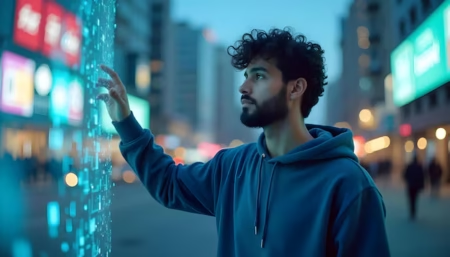
The Digital Age — The Mirror World
Now, our lives flicker on screens.
Our identities dissolve and reform in pixels and code.
We live in two worlds — the seen and the shared.
The Emotion of an Era
Every generation carries its own ache and anthem.
The Zeitgeist of today feels like static electricity —
charged with uncertainty, humming with hope.
We stand between apocalypse and awakening.
We talk of AI, identity, climate, love —
of finding meaning in a world that scrolls too fast.


The Zeitgeist now is restless, curious, and raw.
It hungers for authenticity.
It questions everything once accepted as truth.
It loves deeply and fights loudly,
because silence has lost its virtue.
Art as the Voice of Zeitgeist
Art has always been the mirror of time.
From cave walls to digital canvases,
we have drawn our dreams and fears across generations.
When the world trembles, art speaks.
When words fail, paint screams.
The Zeitgeist of every age
is etched in its music, its colors, its architecture.
Think of the Renaissance — hope reborn in marble.
Think of Jazz — rebellion in rhythm.
Think of Hip-Hop — truth wrapped in beat.
Think of NFTs — the digital soul’s signature.
Each expression says, “We were here. We felt this.”
The Spiritual Pulse of Zeitgeist
Beyond culture and economy lies the unseen pulse —
the spiritual heart of humanity’s age.
In ancient times, faith shaped the spirit.
In the Renaissance, curiosity did.
In today’s world, it is searching that defines us —
not for gods or gold,
But for meaning.
We scroll for connection.
We meditate to escape noise.
We plant trees to heal what was broken.
Our Zeitgeist is not lost — it is becoming.
The Dark Side of Zeitgeist
But every era has its shadow.
The same flame that enlightens can also burn.
The Zeitgeist of fame, of endless validation —
It feeds our loneliness in golden cages.
We measure worth by hearts and followers,
forgetting the quiet truth of existence.
Yet even here, beauty stirs.
For within chaos, consciousness awakens.
Every storm births a clearer sky.
Zeitgeist in You
The truth of Zeitgeist is simple —
It isn’t just “out there.” It lives within us.
Every thought you share,
every rebellion you whisper,
every love you dare —
You are part of this spirit;
You are shaping the song of the age.
We are the authors of now.
Our fears and dreams write history’s rhythm.
How to Feel the Zeitgeist
You cannot see Zeitgeist in books.
You must feel it in motion.
Watch the art that moves people.
Listen to the songs that define a decade.
Observe the stories that shape conversations.
Look into the eyes of the young —
Their fire will tell you where the wind is blowing.
Zeitgeist is everywhere.
In your playlists, your protests, your prayers.
It is the poetry of the present.
Conclusion — The Pulse Beneath the Clock
Time ticks, but spirit breathes.
And the Zeitgeist —
that sacred breath —This
is what gives each moment its meaning.
We are all echoes of our age,
but within that echo lies creation.
The spirit of this time may be uncertain,
but it is alive — bold, tender, and unfinished.
It is a question without an answer,
a song still being written.
And perhaps that is the beauty of it —
That Zeitgeist is not a cage, but a current.
We do not follow it.
We become it.
FAQs
1. What does “Zeitgeist” mean?
It means “spirit of the age” — the cultural, intellectual, and emotional mood of a specific time.
2. Who coined the term “Zeitgeist”?
German philosophers in the 18th century, notably Hegel, popularized it to describe the collective spirit of an era.
3. What is today’s Zeitgeist?
Today’s spirit is digital, connected, restless — defined by identity, technology, and the search for meaning.
4. How does art reflect Zeitgeist?
Art captures emotion and thought, becoming a mirror of the collective consciousness of an age.
5. Why is understanding Zeitgeist important?
Because to know the spirit of your time is to understand your own reflection in history’s mirror.